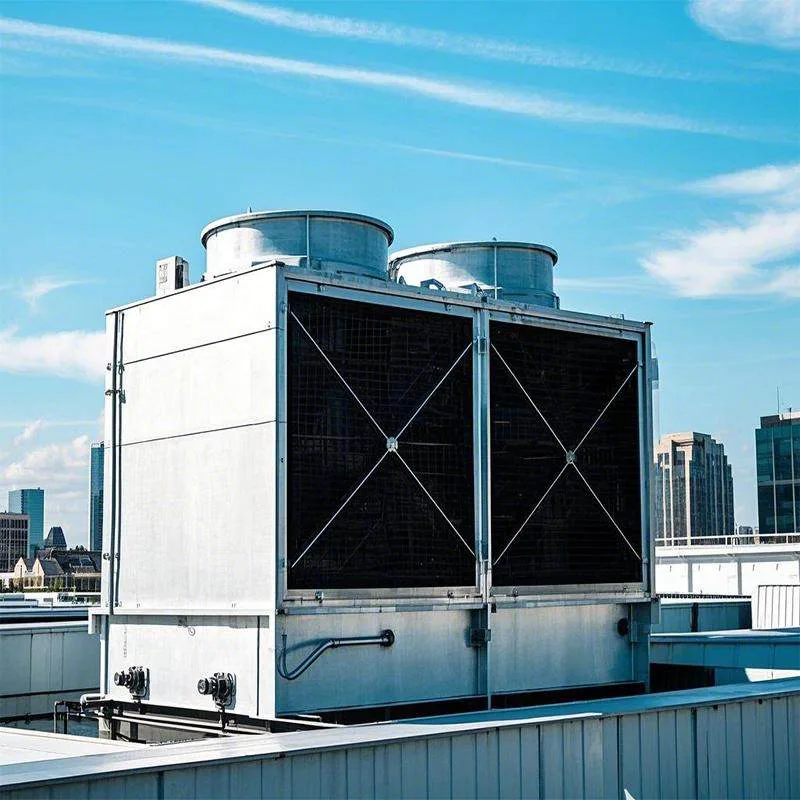
Square Water Tower
A Square Water Tower is a common water tower structure with a cubic or rectangular water tank. Compared with cylindrical towers, square towers offer better space utilization and easier integration with buildings, and construction can be relatively simple. However, water pressure at corners is less uniform, and walls often require additional reinforcement. Square water towers are commonly used in industrial facilities, residential areas, public buildings, or locations with specific architectural requirements, and their modern linear appearance is also suitable for landscape or iconic structures.
A square water tower is a common type of water tower structure where the main water storage tank is cubic or rectangular in shape. Compared to cylindrical water towers, square water towers have the following characteristics:
1.Structural Features:
● Shape: The tank section is a regular geometric square, typically constructed from reinforced concrete or steel plates.
● Support: Usually supported by a grid of columns at the base, brackets, or an underlying building structure.
● Structural Design: Compared to cylindrical shapes, stress may concentrate more at the corners of square structures. Therefore, special reinforcement at the edges and corners is essential during design and construction to withstand water pressure and external loads.
2.Advantages:
● Space Utilization: The square structure allows for more efficient use of space, especially when integrating with existing buildings or in area-constrained sites.
● Construction Convenience: Formwork fabrication and construction can be relatively simpler, particularly for concrete structures, as straight-line formwork is easier to assemble.
● Ease of Integration: Easier to combine with square buildings or facilities, offering more cohesive and unified aesthetics.
3.Disadvantages:
● Structural Efficiency: In terms of hydrostatic pressure distribution and material usage efficiency, circular tanks are superior. The walls of a square tank must withstand greater bending moments, often requiring thicker walls or more reinforcement to resist water pressure, which can increase material consumption.
● Water Pressure Distribution: Water pressure distribution at the corners is less uniform compared to circular tanks.
● Maintenance: Internal corners may be more prone to sediment accumulation, making cleaning slightly more challenging.
4.Applications:
Commonly used in industrial facilities, residential areas, public buildings, or situations with specific architectural styling requirements. Their appearance offers a more modern and linear aesthetic, and they are sometimes used in landscape design or as iconic structures.
Related Category
Send Inquiry
Contact Info
-
Address
567 Songwei North Road, Songjiang District, Shanghai, China
-
Tel
-
Email
For inquiries about our products or pricelist, please leave your email to us and we will be in touch within 24 hours.
Related Products
News Recommendations