Why Two stage Compression Variable Frequency Screw Air Compressors Are Changing the Game
If you manage a production facility, you already know that compressed air is often referred to as the "fourth utility"—right up there with electricity, water, and gas. It's essential, invisible, and remarkably expensive to produce. In many manufacturing plants, air compressors account for 15% to 40% of total electricity consumption, making them one of the largest single electrical loads on the factory floor.
For years, the industry relied on fixed-speed, single-stage screw compressors. They worked—but at a cost. Today, the landscape is shifting rapidly toward a more intelligent, more efficient alternative: the Two-stage Compression Variable Frequency Screw Air Compressor.
The Science of Saving Energy: Why Two Stages Beat One
To understand the efficiency gain, it helps to look at the thermodynamics of compression.
In a single-stage compressor, air is drawn in and compressed from atmospheric pressure to final discharge pressure in one step—say, from 1 bar to 8 bar. This rapid compression generates significant heat, and much of the electrical energy input is lost as thermal energy rather than being converted into useful work.
A two-stage compressor takes a different approach, splitting the compression process into two steps:
-
First stage: Air is compressed to an intermediate pressure (typically around 3 to 4 bar).
-
Inter-stage cooling: The hot, compressed air passes through a cooling system (air- or oil-cooled) to reduce its temperature before entering the second stage.
-
Second stage: The cooled air is further compressed to the final discharge pressure.
Why does this matter? Thermodynamic principles tell us that compression consumes the least energy when it approaches an isothermal process—that is, when the temperature of the gas remains constant throughout. By cooling the air between stages, the two-stage design brings the actual compression curve significantly closer to this theoretical ideal. At the same pressure ratio, this delivers a 15% to 20% improvement in energy efficiency compared to single-stage compression.
The Variable Frequency Drive Advantage: Intelligence Meets Efficiency
If two-stage compression is the "engine" of efficiency, the variable frequency drive is the "brain."
Traditional fixed-speed compressors operate in a simple load/unload fashion. When demand drops, the compressor continues running at full speed but in an unloaded state—still consuming up to 40% of full-load power while producing zero useful air. This is pure waste.
A VFD-equipped compressor, by contrast, adjusts the motor speed continuously to match real-time air demand. It runs faster when demand is high, slower when demand drops, and only stops when truly necessary. For facilities with fluctuating air consumption—which is most facilities—this translates into additional energy savings of 20% to 35% on top of the two-stage compression gain.
Combined, a Two-stage Compression Variable Frequency Screw Air Compressor can deliver total energy savings of 30% to 50% compared to a conventional fixed-speed single-stage unit.
Beyond Energy Bills: Other Practical Benefits
While electricity savings are the headline, they are far from the only advantage. Here are several other practical benefits that facility managers and maintenance teams appreciate:
1. Extended Equipment Lifespan Because the pressure ratio is split across two stages, each stage operates with a lower pressure differential. This significantly reduces the bearing load—roughly one-third of that found in single-stage designs. Lower bearing load means less wear, longer service intervals, and a longer overall compressor life.
2. Quieter Operation Two-stage compressors run more smoothly and produce noticeably lower noise levels compared to their single-stage counterparts. For plant operators spending long hours near the equipment, this is a measurable improvement in working conditions.
3. Stable Discharge Pressure VFD technology provides precise pressure control, maintaining discharge pressure within a very tight tolerance (±0.1 bar). For processes sensitive to pressure fluctuations—such as blow molding, textile manufacturing, or precision machining—this stability directly improves product quality and reduces scrap rates.
4. Soft Start and Reduced Mechanical Stress The VFD enables a soft start, gradually ramping up motor speed rather than delivering a sudden jolt of torque. This eliminates current spikes (reducing strain on the electrical network) and minimizes mechanical shock to drive components such as couplings and belts.
What the Spec Sheet Looks Like: A Quick Reference
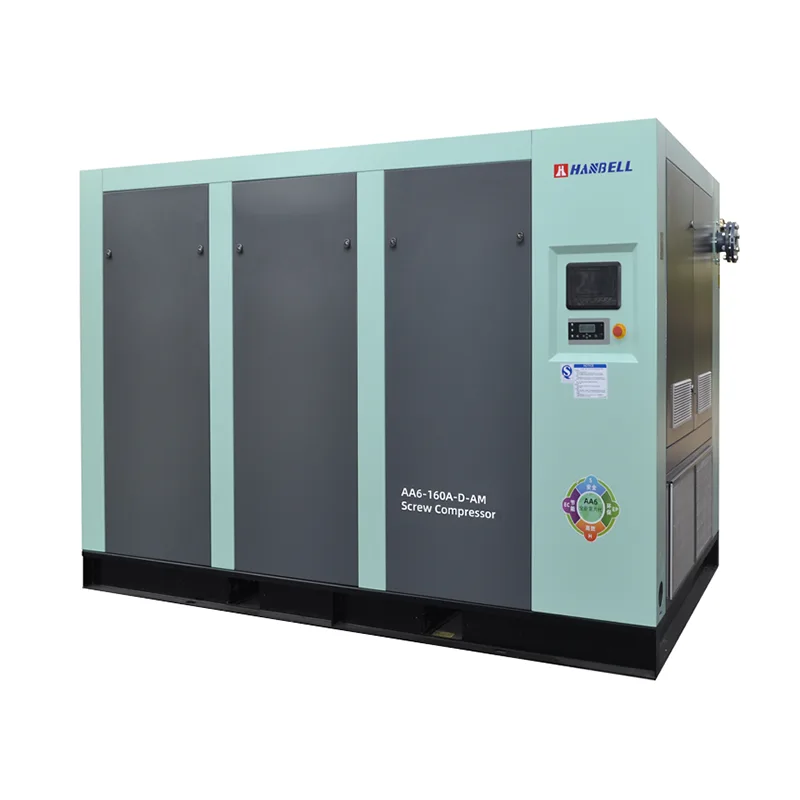
To give you a sense of real-world performance, here are representative parameters for Two stage Compression Variable Frequency Screw Air Compressors at the common discharge pressure of 0.8 MPa (8 bar):
| Power (kW) | Pressure (MPa) | Flow Rate (m³/min) | Approx. Weight (kg) |
|---|---|---|---|
| 45 | 0.8 | ~10.0 | ~2,280 |
| 55 | 0.8 | ~13.2 | ~2,350 |
| 75 | 0.8 | ~15.0 | ~2,400 |
| 90 | 0.8 | ~19.5 | ~3,750 |
| 110 | 0.8 | ~23.0 | ~4,180 |
| 132 | 0.8 | ~27.0 | ~4,280 |
| 160 | 0.8 | ~33.0 | ~4,400 |
| 185 | 0.8 | ~39.0 | ~5,900 |
| 200 | 0.8 | ~41.5 | ~8,000 |
| 250 | 0.8 | ~51.0 | ~8,200 |
Note: Values are representative of mainstream models and may vary by manufacturer. Always refer to official technical documentation for exact specifications.
Advanced Design Features Worth Considering
If you are evaluating suppliers or models, here are some advanced design elements that distinguish higher-end units from entry-level offerings:
-
Permanent Magnet Synchronous Motors (PMSM): These motors deliver higher efficiency across a wider speed range compared to standard induction motors. They are particularly advantageous at low speeds, where induction motors tend to lose efficiency. For a VFD compressor, PMSM is the ideal match.
-
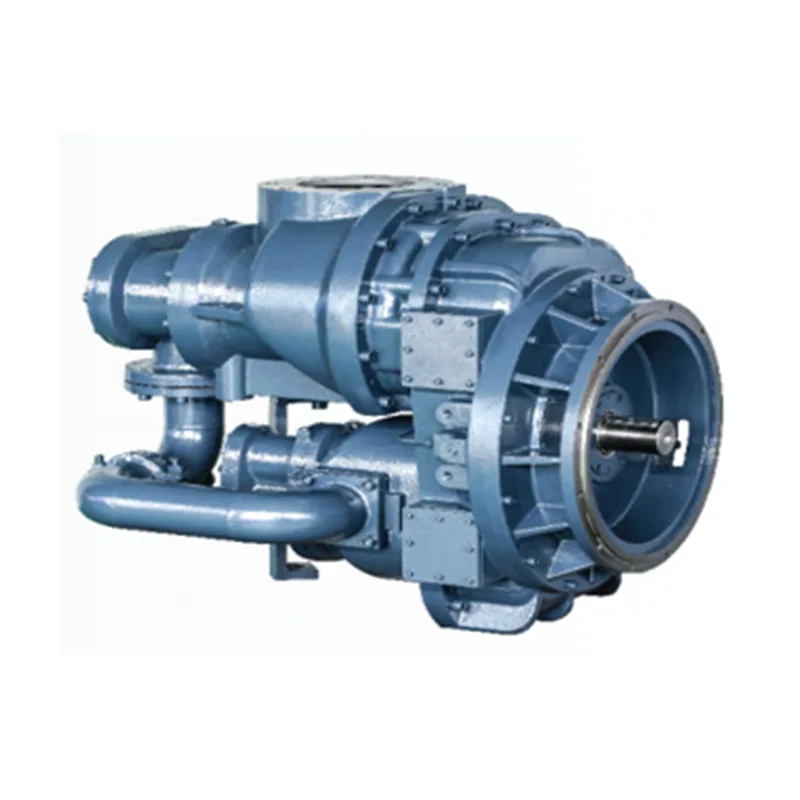
Independent Dual-Drive Motors: Some premium models use two separate motors to drive each compression stage independently. This design allows for easier maintenance, as each stage can be serviced or replaced individually—potentially reducing repair costs by nearly half.
-
Integrated Host Design: Other manufacturers opt for a single housing that contains both stages with gear-driven synchronization. This approach offers a more compact footprint and high transmission efficiency.
-
Advanced Inter-stage Cooling: Innovations such as oil atomization cooling or integrated inter-coolers reduce pressure losses between stages, further boosting overall efficiency.
The ROI Picture
The obvious question: Does the higher initial investment justify the cost?
For most industrial applications, the answer is a clear yes. The energy savings alone typically allow the premium cost of a Two stage Compression Variable Frequency Screw Air Compressor to be recovered within 12 to 24 months of continuous operation. After that, the savings go directly to the bottom line—year after year.
Related News
- Why Does Compressed Air Demand Fluctuation Affect Compressor Selection?
- Variable Frequency Screw Air Compressor: How Energy-Saving Technology Is Changing Industrial Compressed Air Systems
- Optimizing Industrial Efficiency: The Easy-Maintainable Two-Stage Permanent Magnet Variable Frequency Air Compressor
- The "Dual-Core" Era of Compressed Air: Why Two-Stage PM VFD Compressors Are Becoming the Energy-Saving Gold Standard
- Integrated Variable Frequency Screw Air Compressor: Transforming Compressed Air from a Cost Center into a Profit Driver
- The Real Cost-Saving Math: How Two-Stage Permanent Magnet Variable Frequency Screw Air Compressors Cut Your Electricity Bill
Leave me a message